
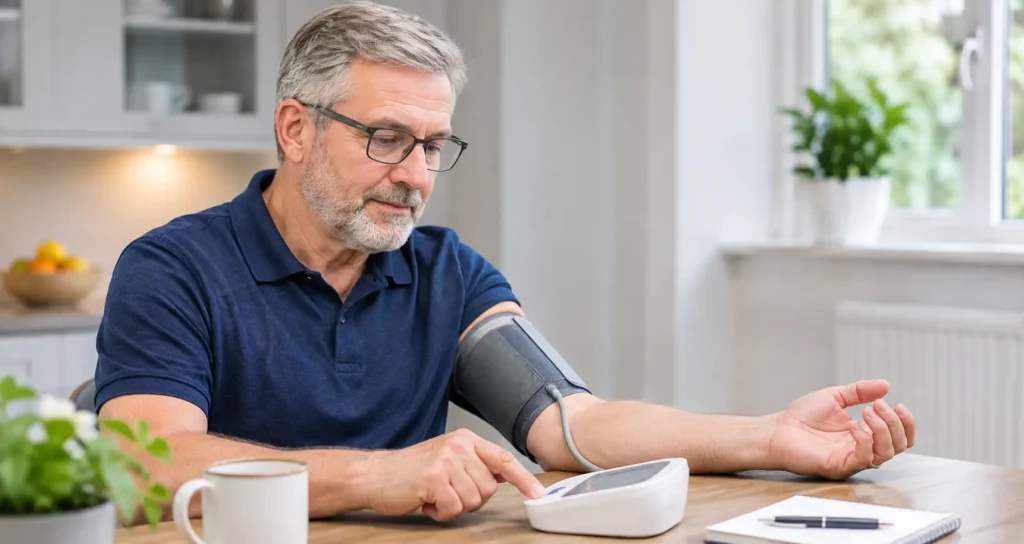
Home blood pressure monitoring can be useful, but technique matters. A reading taken while you are rushed, talking, using the wrong cuff or holding your arm unsupported can be less reliable.
For a more consistent reading, use a validated upper-arm monitor with the correct cuff size, sit quietly with your back supported and feet flat, support your arm, avoid talking and repeat the measurement rather than relying on one number.
Choose a suitable home blood pressure monitor
Use a monitor that has been validated for accuracy and follow the manufacturer’s instructions. NICE advises healthcare professionals to use validated devices and an appropriate cuff size, and the same principles are sensible for home monitoring.
Upper-arm monitors are commonly used for home readings. Whatever device you use, the cuff must fit correctly and be positioned as the instructions specify.
Prepare before you measure
Give yourself time to settle before checking your blood pressure. Sit quietly, avoid talking and try not to take the reading immediately after rushing around, smoking, caffeine or exercise.
If a healthcare professional has given you a specific monitoring plan, follow that plan rather than using a generic schedule.
Sit in the right position
Sit on an upright chair with your back supported and both feet flat on the floor. Keep your legs uncrossed. Rest your arm on a table or other surface so that it is supported and relaxed.
Put the cuff around bare skin rather than over thick clothing. Stay still, breathe normally and do not talk while the monitor is taking the reading.
Take more than one reading
The NHS advises taking another reading after the first to check that the result is consistent. If you have been asked to monitor at home, you may be asked to record readings in the morning and evening.
When home monitoring is being used to confirm hypertension, NICE advises two consecutive seated measurements at least 1 minute apart, twice daily, for at least 4 days and ideally 7 days.
Record your results consistently
Write down the date, time and readings, or use the memory function on your monitor if appropriate. Try to measure at similar times during a monitoring period so the pattern is easier to interpret.
If your clinician has asked you to record symptoms, medicines or other factors alongside the readings, include those too.
Common reasons a reading may be misleading
- the cuff is too small, too large or positioned incorrectly;
- the cuff is placed over clothing;
- you are talking, moving or tense during the reading;
- your back, feet or arm are unsupported;
- you have just exercised, smoked or had caffeine;
- you are relying on one isolated reading rather than a pattern.
What if your home reading is high?
One high reading does not by itself confirm hypertension. The NHS generally considers home blood pressure high if it is 135/85 mmHg or higher, but diagnosis is based on an appropriate series of readings rather than one result.
If readings remain high, or are very different from your usual pattern, speak to a GP, pharmacist or other healthcare professional. Do not change prescribed treatment on your own.
When to seek medical advice
Seek medical advice if readings are repeatedly very high or very low, or if you have symptoms such as dizziness, fainting, severe headache, chest pain, severe breathlessness, confusion or weakness.
Call 999 for a life-threatening emergency, including symptoms that could suggest a heart attack or stroke.
Home monitoring and pharmacy support in Luton
If you want a professional blood pressure check for comparison, Biscot Pharmacy currently provides NHS blood pressure checks and has a booking route for this service.
For broader local healthcare support, visit our local pharmacy in Luton page. If you are attending for a pharmacy reading, see how to prepare for a pharmacy blood pressure check. You can also book a blood pressure check online.
Frequently Asked Questions
What is the safest approach to taking a home blood pressure reading?
Use a validated upper-arm monitor with the correct cuff size, sit quietly with your back supported and feet flat, support your arm, avoid talking during the test and repeat the reading after about 1 minute.
When should I ask a pharmacist about home monitoring?
Ask a pharmacist if you are unsure whether your device or cuff is suitable, if your readings are repeatedly outside your usual range, or if you want a professional check for comparison.
Can I change how I take or use a medicine without professional advice?
No. Do not change, stop or start prescribed blood-pressure medicines based on a single home reading. Share your readings with the clinician or pharmacist responsible for your care.
When should I contact my GP or NHS 111 instead of relying on general pharmacy advice?
Seek medical advice if readings are repeatedly very high or very low, or if you have symptoms such as fainting, chest pain, severe breathlessness, new weakness, confusion or another concerning symptom. Call 999 for a life-threatening emergency.
Important
This article provides general information and does not diagnose high or low blood pressure. Follow the monitoring plan given by your GP, nurse, pharmacist or other clinician, and do not change prescribed medicine based on a single home reading.


 the prescription app


