
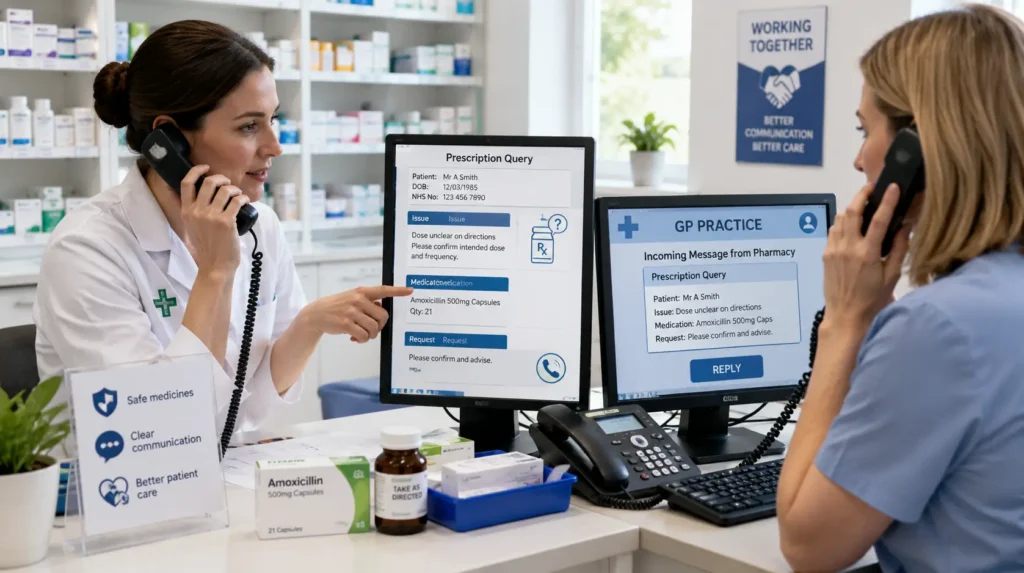
If a prescription or medicine detail looks unclear, your community pharmacy and GP practice may need to communicate before the medicine can be supplied or before your record is updated. This is a normal part of care coordination and does not automatically mean that anyone has made a serious mistake.
Pharmacists check prescriptions before dispensing and may need to clarify information with the prescriber. In other situations, a community pharmacy may send information back to a GP practice after an NHS pharmacy service so that the patient record can be updated. The exact process depends on why the communication is needed, which NHS service is involved and whether the prescription has already been issued.
Why Pharmacists May Need to Contact a GP Practice
A pharmacist may need to contact a GP practice when the information available is not enough to safely or accurately complete the next step. Common examples include a prescription that is incomplete or unclear, a change that has been discussed but is not yet reflected on the prescription, or a question that needs the prescriber to confirm their intended instruction.
The aim is to make sure the pharmacy is working from the correct and current information. NHS Business Services Authority guidance explains that where prescription details are missing or a change is required, the prescriber may need to provide further information or issue an amended prescription. For electronic prescriptions, a prescriber may need to cancel and regenerate the prescription when a genuine amendment is required.
Types of Information That May Need Clarification
The information that needs checking will depend on the prescription. A pharmacy may need to clarify:
· which medicine the prescriber intended
· the strength, quantity or directions when these are missing or unclear
· whether an older item should still be supplied after a recent treatment change
· whether a prescription has been cancelled, replaced or reissued
· whether the pharmacy should wait for a new prescription before completing the supply
Not every query requires a new prescription. Some matters can be resolved through an authorised clarification process, while others require the prescriber to take formal action. The pharmacy team should not guess when the intended prescription is uncertain.
How Prescription or Medicine Changes May Be Communicated
Community pharmacies and GP practices can communicate in several ways. Depending on the situation, this may involve a telephone call, secure NHS email or a structured digital message. Some national community pharmacy services can send consultation summaries directly into GP practice workflows, while urgent or time-sensitive matters may still need direct contact.
Electronic Prescription Service (EPS) records are also part of the process. If an electronic prescription genuinely needs amending, NHS guidance says it cannot simply be edited as though it were a draft document after it has been sent. The prescriber may need to cancel and reissue it. If you are unsure where your prescription has been sent, our guide on how to nominate a pharmacy for electronic prescriptions explains the separate EPS nomination process.
What the Pharmacy Can and Cannot Change Independently
A community pharmacist is responsible for checking the prescription and deciding whether it can be dispensed appropriately. That does not normally mean the pharmacist can freely rewrite a prescription issued by a GP.
Where a prescription change requires the prescriber’s authority, the pharmacist may need to contact the prescriber and wait for clarification or a replacement prescription. There are limited exceptions under pharmacy and prescribing rules, and some pharmacists are qualified independent prescribers who can prescribe within their own competence and authorised service. That is a separate prescribing decision, not the same as informally changing a GP-issued prescription.
For patients, the practical point is simple: if the pharmacy says it needs to check something with your GP practice, it is usually because the pharmacy needs confirmed information before it can complete the next step safely and correctly.
What Patients May Be Asked to Do
Sometimes the pharmacy can contact the GP practice directly. At other times, you may be asked to contact the practice yourself, especially if the GP needs to review the request, authorise a repeat item or discuss a treatment decision with you.
You may be asked to:
· wait while the pharmacy contacts the prescriber
· contact your GP practice to request a review or a replacement prescription
· check the prescription status in the NHS App where that information is available
· confirm which medicine or dose you are currently using
· bring the medicine packaging, label or recent instructions if that helps identify the issue
· avoid placing a duplicate prescription request unless the pharmacy or GP practice tells you to do so
If you are not sure which part of the process is delayed, ask the pharmacy whether it is waiting for the prescription, waiting for a clarification, or waiting for the GP practice to issue a new prescription.
What Happens When an Issue Is Urgent or Still Unclear
Urgency changes the route, but it does not remove the need for accurate information. If you are close to running out of a regular prescribed medicine, tell the pharmacy or GP practice rather than waiting until the last dose. If you have completely run out and cannot reach your GP practice, the NHS 111 emergency prescription service can advise on the options available.
If the concern is about a new symptom, side effect or whether a medicine is clinically suitable for you, that is a different question from prescription administration. A pharmacist can advise on the appropriate next step, but this article does not provide individual treatment advice.
When to Contact the Pharmacy or GP Practice
| Situation | Best first contact |
| You are unsure whether the pharmacy has received the prescription | Pharmacy |
| The pharmacy says a prescription detail needs clarification | Pharmacy first; GP practice if the pharmacy asks you to contact them |
| Your GP has changed your treatment but the new prescription has not been issued | GP practice |
| A medicine on your NHS App repeat list looks wrong or unfamiliar | GP practice |
| You need help understanding a label, collection status or how the pharmacy is processing the prescription | Pharmacy |
| You have completely run out of regular medicine and your GP is unavailable | NHS 111 / urgent prescription route |
If Biscot Pharmacy is your chosen pharmacy and you have a non-urgent prescription query, you can contact Biscot Pharmacy for help understanding what stage the prescription has reached. You can also view our wider pharmacy services in Luton.
Why Clear Communication Matters
Good communication between community pharmacy and general practice helps reduce avoidable delays, prevents conflicting information and supports an accurate patient record. NHS England has continued to expand secure digital communication between community pharmacy and GP practices, including structured consultation updates for certain community pharmacy services and dedicated routes for pharmacy-to-practice communication.
For patients, the most useful approach is to keep the pharmacy and GP practice informed when something has changed, respond if either team asks for clarification, and avoid assuming that a medicine change discussed in one setting has automatically updated every prescription or system immediately.
For non-urgent prescription and medicine-process questions, Biscot Pharmacy can help you understand whether the next step sits with the pharmacy or your GP practice. Contact the pharmacy if you are unsure whether a prescription has arrived, is being prepared, or needs clarification.
Frequently Asked Questions
Can a pharmacist contact my GP about a medicine change?
Yes. A community pharmacist may contact your GP practice or another prescriber when a prescription is unclear, when a medicine-related issue needs clarification, or when information needs to be shared for continuity of care. The exact route depends on the situation and the NHS systems available.
Why might a pharmacy need to check a prescription with a GP?
A pharmacy may need to check details such as the intended medicine, strength, quantity or directions, or confirm whether a newer instruction has replaced an older prescription. If information is missing or a prescription needs to be reissued, the prescriber may need to take action before dispensing can continue.
Can a pharmacist change my prescription without speaking to my GP?
Usually, a community pharmacist cannot simply rewrite a GP-issued prescription. For many electronic prescriptions, a required change is made by the prescriber, who may need to cancel and reissue the prescription. There are limited legal and professional exceptions, and a pharmacist who is also an independent prescriber may prescribe within their own authorised scope, but that is different from casually editing another prescriber’s prescription.
What should I do if my medicine or prescription has changed?
Use the latest confirmed instructions you have been given and contact the pharmacy or GP practice if anything is unclear. Avoid submitting a duplicate prescription request unless you are advised to do so. If you have completely run out of a regular medicine and cannot reach your GP, NHS 111 can advise on urgent prescription options.
Disclaimer
This article explains community-pharmacy and GP-practice communication in general terms. It does not provide individual medical advice, diagnose a condition, or authorise a change to your prescribed treatment. Prescription processes can vary according to the medicine, prescription type, NHS service and local systems. If you are unsure what medicine you should take or which instructions apply to you, contact your pharmacist or prescriber. If you have completely run out of regular medicine and cannot reach your GP, NHS 111 can advise on urgent prescription options.


 the prescription app


