
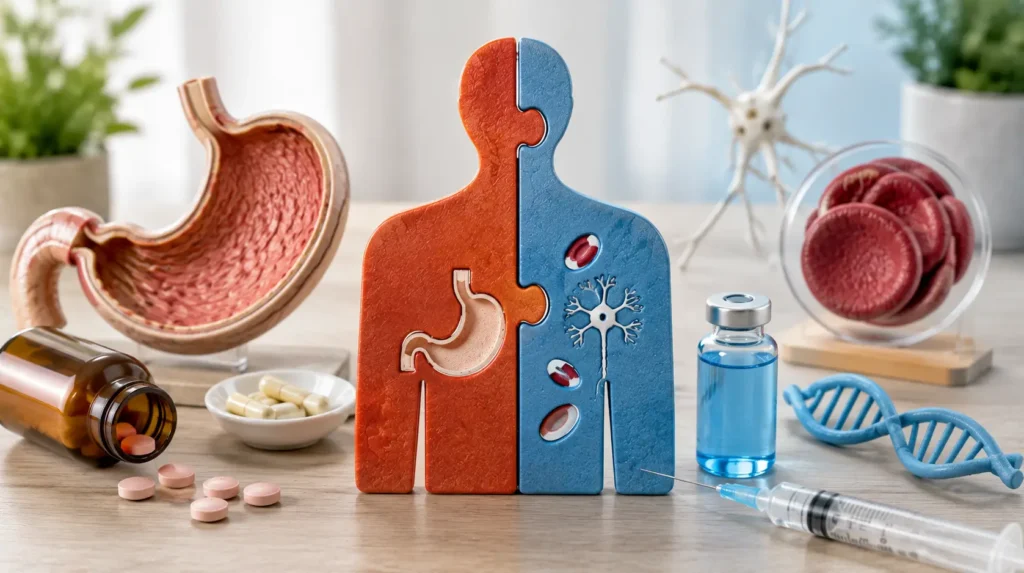
Vitamin B12 deficiency and pernicious anaemia are related, but they are not the same thing. Vitamin B12 deficiency describes the state of not having enough vitamin B12 for normal body function. The term pernicious anaemia has historically been used for a particular autoimmune problem with B12 absorption and for the severe anaemia that can result from long-standing deficiency. Current NICE guidance prefers the term autoimmune gastritis for the underlying stomach condition because using “pernicious anaemia” for both the cause and the consequence can be confusing.
The practical difference matters because vitamin B12 deficiency has many possible causes. A temporary dietary deficiency may be managed very differently from autoimmune gastritis, which NICE treats as an irreversible cause requiring lifelong intramuscular vitamin B12 replacement when it is confirmed or suspected. This page focuses on that cause-and-diagnosis distinction rather than repeating a broad symptoms or injection-service guide.
Pernicious anaemia vs B12 deficiency at a glance
| Comparison point | Vitamin B12 deficiency | Pernicious anaemia / autoimmune gastritis context |
| What it describes | A state in which the body does not have enough vitamin B12 for normal function. | A term historically used for severe B12-deficiency anaemia and commonly used for autoimmune loss of B12 absorption. NICE now uses “autoimmune gastritis” for the underlying stomach condition. |
| Possible causes | Dietary insufficiency, autoimmune gastritis, stomach or bowel surgery, coeliac disease, some medicines, nitrous oxide and other causes. | Most relevant when an autoimmune stomach process damages parietal cells and reduces intrinsic factor, impairing B12 absorption. |
| Is anaemia required? | No. NICE says B12 deficiency should not be ruled out just because anaemia or macrocytosis is absent. | The name contains “anaemia”, but the autoimmune cause can be identified before severe anaemia develops. |
| Cause testing | The initial B12 test shows whether deficiency is likely; further investigation may be needed to find the cause. | If autoimmune gastritis is suspected, NICE says to consider anti-intrinsic factor antibody testing. A negative result does not rule it out. |
| Treatment pattern | May involve diet, oral B12 or intramuscular B12 depending on cause and clinical circumstances. | NICE recommends lifelong intramuscular B12 replacement when autoimmune gastritis is the confirmed or suspected cause. |
| Reversibility | Some causes are reversible; others are permanent. | Autoimmune gastritis is an irreversible cause, so long-term management differs from a temporary dietary deficiency. |
What is vitamin B12 deficiency?
Vitamin B12 deficiency means the body does not have enough usable vitamin B12. The vitamin is needed for normal red blood cell formation and healthy nervous-system function. A deficiency can affect the blood, brain and nerves, but the pattern varies between people and the symptoms are not specific to one condition.
Importantly, vitamin B12 deficiency is not the same as vitamin B12 deficiency anaemia. NICE specifically says clinicians should not rule out B12 deficiency just because anaemia or enlarged red blood cells are absent. A person can therefore have neurological, cognitive or other B12-related problems before an obvious anaemia is present. For a dedicated overview of warning features, see our guide to vitamin B12 deficiency symptoms.
What is pernicious anaemia – and why does NICE use “autoimmune gastritis”?
In everyday UK health information, pernicious anaemia is commonly used to describe an autoimmune condition in which the immune system affects stomach cells involved in vitamin B12 absorption. NHS information explains that this can reduce the body’s ability to absorb B12 from food because intrinsic factor is affected.
NICE NG239 makes a more precise terminology distinction. It defines autoimmune gastritis as a chronic inflammatory condition of the stomach that can destroy parietal cells, reduce stomach acid and impair intrinsic-factor production. NICE notes that autoimmune gastritis is sometimes referred to as pernicious anaemia, but that “pernicious anaemia” in its strict sense is a severe, potentially life-threatening anaemia caused by chronic B12 deficiency. Because that severe presentation is now uncommon and the term is used inconsistently, NICE does not use pernicious anaemia as a synonym for autoimmune gastritis in its recommendations.
For readers, the safest interpretation is this: not every vitamin B12 deficiency is pernicious anaemia, and when someone says “pernicious anaemia” they may actually be referring to autoimmune gastritis as the underlying irreversible cause of B12 malabsorption.
How autoimmune gastritis can lead to vitamin B12 deficiency
Vitamin B12 from food normally has to be released and then absorbed through a sequence involving the stomach and the end of the small intestine. Parietal cells in the stomach help produce gastric acid and intrinsic factor. Intrinsic factor binds vitamin B12 so that it can later be absorbed in the terminal ileum.
Autoimmune gastritis can damage those parietal cells. NICE explains that this can reduce gastric acid, making it harder to release B12 from food, and can reduce intrinsic factor, further impairing B12 absorption. The same stomach process can also affect iron absorption. Because the underlying autoimmune problem is permanent, simply eating more B12-rich food does not correct the absorption mechanism.
Does pernicious anaemia always mean you are anaemic?
No – and this is one reason the terminology can cause confusion. Vitamin B12 deficiency can exist without anaemia, and autoimmune gastritis can be recognised before a person develops severe B12-deficiency anaemia. The word “anaemia” in the older term should therefore not be used to dismiss possible B12 deficiency when haemoglobin or red-cell size looks normal.
The reverse is also important: having vitamin B12 deficiency does not prove that autoimmune gastritis is the cause. Diet, gastrointestinal surgery, coeliac disease, medicines and other factors can produce the same deficient state through different mechanisms.
How are vitamin B12 deficiency and autoimmune gastritis diagnosed?
The first step is usually to establish whether vitamin B12 deficiency is likely. NICE recommends total B12 or active B12 as the initial diagnostic test for most adults, with different pathways in pregnancy and when recreational nitrous oxide use is suspected. Results are interpreted alongside symptoms, risk factors, medical history and other findings rather than in isolation.
If deficiency is confirmed and autoimmune gastritis is suspected, NICE says to consider an anti-intrinsic factor antibody test unless it has already been positive or certain gastrointestinal surgery makes the cause clear. A negative anti-intrinsic factor result does not rule out autoimmune gastritis. If suspicion remains, further investigations can include parietal-cell antibodies, gastrin testing, a B12 absorption test or specialist gastroscopy with gastric-body biopsy. For more detail on the timing of testing before replacement, read our guide to B12 blood testing before treatment.
Can other causes of B12 deficiency look similar?
Yes. Different causes can lead to similar low B12 results and overlapping symptoms. NICE lists dietary insufficiency, coeliac disease, other autoimmune conditions, gastrointestinal surgery, several medicines and recreational nitrous oxide among recognised risk factors. Previous stomach or ileal surgery can cause permanent malabsorption, while diet or some medicine-related causes may be reversible.
Medicine history is especially important because it may explain or contribute to a low result without being the only possible cause. For example, current UK safety advice recognises reduced B12 as a common effect of metformin. If that applies to you, our article on metformin and vitamin B12 monitoring explains the separate medicine-related pathway without assuming autoimmune gastritis.
Why the cause changes the treatment plan
Vitamin B12 replacement is not one fixed treatment for every cause. Diet-related deficiency may sometimes be treated with dietary improvement and oral vitamin B12. Some other causes can be managed with oral or intramuscular replacement depending on absorption, symptoms, adherence and clinical judgement.
Autoimmune gastritis is different because NICE classifies it as an irreversible cause. When autoimmune gastritis is the confirmed or suspected cause of vitamin B12 deficiency, NICE recommends lifelong intramuscular vitamin B12 replacement. This is a cause-based decision, not a general rule that everyone with a low B12 result needs lifelong injections. For a route-focused explanation, see B12 injections vs tablets.
Why identifying autoimmune gastritis matters beyond B12 replacement
Finding the cause can affect follow-up as well as vitamin replacement. NICE advises clinicians to take into account that people with autoimmune gastritis have a higher risk of gastric neuroendocrine tumours and may also have a higher risk of gastric adenocarcinoma. This does not mean everyone with autoimmune gastritis needs the same routine endoscopy schedule.
NICE says new or worsening upper gastrointestinal symptoms – for example persistent dyspepsia, nausea or vomiting – should prompt consideration of gastrointestinal endoscopy and the relevant suspected-cancer guidance. The practical message is to tell the clinician managing your B12 deficiency about new stomach symptoms rather than assuming they are unrelated.
If you already have a diagnosis or treatment plan
If you already have documented vitamin B12 deficiency, recent results or an established replacement plan, Biscot Pharmacy’s private vitamin B12 injection service may be able to support treatment when a pharmacist confirms that the service is clinically appropriate. The pharmacy service does not diagnose autoimmune gastritis and does not replace GP or specialist management of an irreversible cause. A consultation does not guarantee that an injection will be given.
When to seek medical advice promptly
Seek medical assessment for persistent or unexplained symptoms, and seek prompt advice for new or worsening numbness, pins and needles, muscle weakness, balance or walking problems, vision changes, significant memory or thinking changes, or rapidly worsening illness. Vitamin B12 deficiency can affect the nervous system even without anaemia, and delayed treatment can increase the risk of lasting problems.
Use NHS 111 when you need urgent medical advice and the situation is not immediately life-threatening. Call 999 for a medical emergency such as collapse or severe breathing difficulty.
Conclusion
The key pernicious anaemia difference is about cause and terminology. Vitamin B12 deficiency is the deficient state and can arise for many reasons. The condition commonly called pernicious anaemia is closely linked to autoimmune gastritis, an irreversible stomach condition that impairs B12 absorption; NICE now uses “autoimmune gastritis” to describe that underlying cause more precisely.
That distinction changes investigation and long-term treatment. A low B12 result may need further work to identify why it happened, while confirmed or suspected autoimmune gastritis usually means lifelong intramuscular replacement under NICE guidance. Do not assume that every low B12 result is pernicious anaemia, and do not use the presence or absence of anaemia alone to decide whether B12 deficiency is possible.
Written by the Biscot Pharmacy Editorial Team.
Medically reviewed by Faisal Shafiq, Superintendent Pharmacist (GPhC 2067224).
Frequently Asked Questions
Is pernicious anaemia the same as vitamin B12 deficiency?
No. Vitamin B12 deficiency is the state of having insufficient B12. Pernicious anaemia is a term historically linked to severe B12-deficiency anaemia and commonly used for the autoimmune stomach problem that causes B12 malabsorption. NICE now calls the underlying condition autoimmune gastritis.
Can you have vitamin B12 deficiency without anaemia?
Yes. NICE says vitamin B12 deficiency should not be ruled out solely because anaemia or macrocytosis is absent. Neurological or other symptoms can occur without obvious anaemia.
What causes the condition often called pernicious anaemia?
The common modern explanation is autoimmune gastritis. The immune process damages stomach parietal cells, which can reduce gastric acid and intrinsic-factor production and make vitamin B12 harder to absorb.
Can a B12 blood test tell whether I have autoimmune gastritis?
A B12 test can help establish whether deficiency is likely, but it does not by itself prove the cause. If autoimmune gastritis is suspected, NICE says an anti-intrinsic factor antibody test may be considered, with further investigation if suspicion remains.
Does a negative intrinsic-factor antibody test rule out autoimmune gastritis?
No. NICE specifically says a negative anti-intrinsic factor antibody result does not rule out autoimmune gastritis. Further tests or specialist assessment may be considered when clinical suspicion remains.
Does autoimmune gastritis mean B12 injections are lifelong?
For vitamin B12 deficiency caused or suspected to be caused by autoimmune gastritis, NICE recommends lifelong intramuscular vitamin B12 replacement. Other causes of deficiency can have different treatment routes and durations.
Can vitamin B12 deficiency be caused by diet instead?
Yes. Low dietary intake is one recognised cause, particularly when there is no reliable source of vitamin B12. Dietary deficiency is different from autoimmune gastritis because the underlying cause may be reversible and oral replacement may be appropriate.
Disclaimer
This article provides general UK health information and does not diagnose vitamin B12 deficiency, autoimmune gastritis or pernicious anaemia. Blood-test interpretation, investigation of the cause and treatment should be based on your symptoms, medical history, examination and clinical results. Do not start, stop or change prescribed vitamin B12 treatment without advice from the healthcare professional responsible for your care. Seek prompt medical advice for new or worsening neurological symptoms.
Clinical information sources
– NICE NG239 – Vitamin B12 deficiency in over 16s: diagnosis and management
– NHS – Vitamin B12 or folate deficiency anaemia: overview
– NHS – Vitamin B12 or folate deficiency anaemia: causes





 the prescription app


