
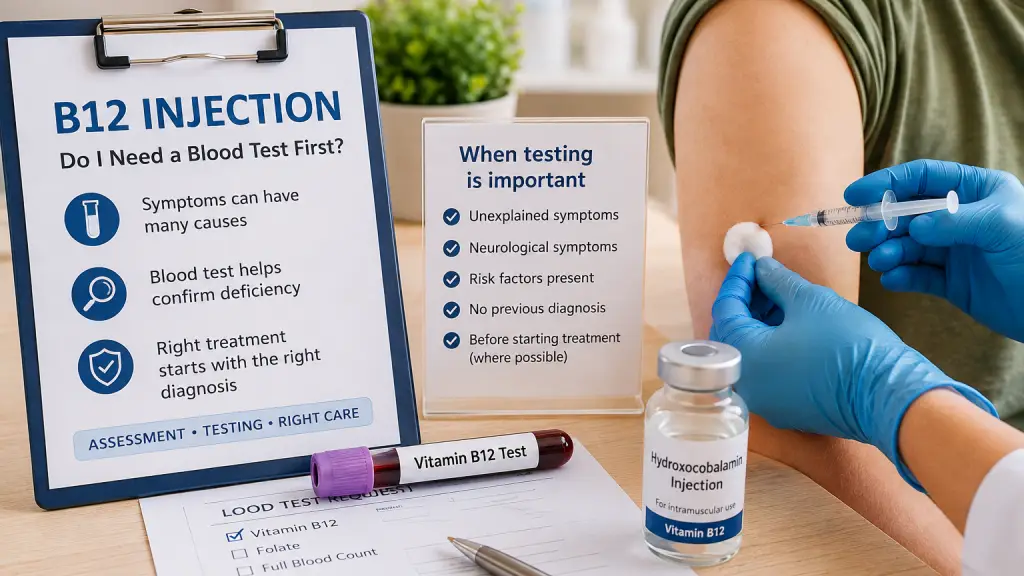
A blood test before B12 injection treatment is often appropriate when vitamin B12 deficiency has not already been established, symptoms are new or unexplained, or the cause of a low B12 level is unclear. NICE recommends taking diagnostic blood samples before starting vitamin B12 replacement whenever the clinical situation allows, because tablets, injections and other B12 products can affect later test interpretation.
That does not mean everyone always needs a new test before every injection. A person with an established diagnosis and treatment plan may already have enough information for ongoing care. Testing decisions depend on symptoms, risk factors, previous results, diagnosis, current supplements or treatment and clinical urgency.
There is an urgent exception. NICE says replacement should not be delayed while waiting for results when a clinician suspects megaloblastic anaemia with neurological symptoms, particularly symptoms linked to sub-acute combined degeneration of the spinal cord. This is a clinician-led decision, not a reason to bypass assessment.
Why symptoms alone do not confirm vitamin B12 deficiency
Tiredness, weakness, poor concentration, memory problems, low mood, pins and needles, numbness, a sore tongue and balance changes can occur with vitamin B12 deficiency. They can also occur with many other conditions. NICE specifically notes that symptoms and signs vary between people and are often not exclusive to B12 deficiency.
Other explanations include iron or folate deficiency, thyroid disease, diabetes, sleep problems, infection, medicine effects, anxiety, depression and other neurological or blood disorders. Symptoms alone should not confirm deficiency, and an injection should not be used as a diagnostic trial or general energy treatment.
The absence of anaemia does not rule out deficiency either. NICE advises clinicians not to exclude vitamin B12 deficiency solely because anaemia or enlarged red blood cells are absent. The safest assessment uses the whole picture: symptoms, risk factors, examination when needed and appropriate test results.
When is a vitamin B12 blood test usually useful?
A vitamin B12 blood test is commonly considered when symptoms could fit deficiency and there are relevant risk factors or clinical reasons to investigate. The decision about a blood test before B12 injection treatment should use clinical judgement rather than one symptom or risk factor in isolation.
Testing can also be relevant when symptoms are persistent, worsening or difficult to explain, even if the initial list of risk factors is not obvious. A GP or another appropriate clinician may investigate B12 alongside a full blood count, folate and other tests depending on the presentation.
· A vegan, vegetarian or otherwise restricted diet with limited reliable sources of vitamin B12.
· Autoimmune conditions, coeliac disease or other conditions that may affect vitamin B12 absorption.
· Previous stomach or bowel surgery, including some bariatric procedures.
· Medicines associated with lower B12 levels, such as metformin or long-term acid-suppressing treatment.
· Older age, frailty, difficulty obtaining or preparing food, or other reasons for reduced dietary intake.
· Recreational nitrous oxide use, which can require a different diagnostic pathway.
Which B12 test may be used?
For most adults with suspected deficiency, NICE identifies total B12 (serum cobalamin) or active B12 (serum holotranscobalamin) as the initial diagnostic test. Active B12 is recommended as the initial test during pregnancy. When recreational nitrous oxide use is the suspected cause, the pathway can differ and may involve methylmalonic acid or homocysteine.
A single result does not always settle the diagnosis. Results must be interpreted with symptoms, risk factors, pregnancy, recent B12 use and the likely cause. If a result is indeterminate or does not fit the clinical picture, a GP or specialist may consider further testing.
The NHS explains that blood tests used when investigating B12 or folate deficiency anaemia can also assess haemoglobin, red-cell size, folate and vitamin B12 levels. Further tests may be needed to understand why a deficiency has developed.
Why is the diagnostic sample normally taken before treatment?
Vitamin B12 replacement can raise measured B12 levels. Tablets, injections, sprays, patches and some supplements may therefore make later results harder to interpret. Taking a B12 diagnostic sample before treatment, when clinically safe to do so, helps preserve useful information about the person’s untreated status.
Tell the healthcare professional about every B12 product you already use, including non-prescription tablets, injections, multivitamins, sprays, patches and high-dose supplements. NICE recommends considering the type and dose because over-the-counter B12 can affect total or active B12 results.
The reason this matters becomes clearer when you understand how vitamin B12 injections work. An injection changes B12 availability without relying on normal gastrointestinal absorption, so treatment can alter the laboratory picture that clinicians are trying to understand.
A pre-treatment sample also helps answer why B12 is low. Diet, autoimmune gastritis, coeliac disease, medicines, surgery and other absorption problems can require different treatment and follow-up. The goal is to identify and manage the cause, not simply raise a laboratory number.
When should urgent B12 treatment not wait for the result?
Testing first is the usual diagnostic principle, but clinical urgency can take priority. NICE says not to delay vitamin B12 replacement while waiting for test results in people with suspected megaloblastic anaemia and neurological symptoms, especially symptoms linked to sub-acute combined degeneration of the spinal cord.
These symptoms require prompt clinical assessment. Contact a GP urgently or use NHS 111 when symptoms are new or worsening and the situation is not immediately life-threatening. Call 999 for a medical emergency. Urgent B12 treatment is a clinician-led exception; it should not be used to justify bypassing diagnosis or assessment.
· New or worsening numbness, pins and needles or loss of sensation.
· Difficulty walking, unsteadiness, falls or loss of coordination.
· Significant muscle weakness or rapidly worsening neurological symptoms.
· Vision changes or marked new cognitive changes.
· Severe breathlessness, fainting, chest pain or another sign of significant illness.
What a blood test can and cannot tell you
A blood test can support diagnosis, but it is not a stand-alone verdict. Some people can have neurological symptoms without obvious anaemia, while others may have a low B12 result with few symptoms. Pregnancy, supplements, laboratory methods, medicines and the underlying cause can also influence interpretation.
If the result supports deficiency, the next decision is usually about cause and treatment route. Some people may be treated with oral vitamin B12, while others may need intramuscular replacement because of malabsorption, surgery, neurological risk or another clinical reason. The evidence-based benefits of B12 injections are clearest when injections are being used to correct a genuine deficiency or meet a defined replacement need.
If results do not support deficiency or do not explain the symptoms, the safer next step may be broader GP assessment rather than continuing injections. Persistent symptoms deserve an explanation even when one test is normal.
Pharmacist assessment or GP assessment: which route is appropriate?
A pharmacist suitability assessment and a GP diagnostic pathway have different roles. The pharmacist can review your information and service suitability. A GP is usually better placed to investigate unexplained symptoms, arrange broader testing, assess underlying disease, manage complex or long-term deficiency and refer when needed.
A pharmacy consultation does not guarantee that an injection will be supplied or administered. If the service is not suitable, the purpose of assessment is to explain a safer next step rather than to provide treatment automatically.
· A pharmacist may review recent B12, folate or full blood count results and an established diagnosis or treatment plan.
· The pharmacist can review symptoms, medicines, supplements, allergies, pregnancy or breastfeeding and relevant medical history.
· The pharmacist may advise that a new blood test or GP assessment is needed before treatment.
· A GP may investigate other causes of symptoms and arrange additional tests when the diagnosis is uncertain.
· Urgent or progressive neurological symptoms should not wait for a routine private pharmacy appointment.
What to bring to a B12 assessment
Useful recent information can make the assessment more efficient and reduce avoidable repeat testing. You do not need every item, but accurate records help the pharmacist or GP understand what has already been investigated.
Do not stop a prescribed medicine or change an established B12 treatment plan just to prepare for an appointment unless the clinician responsible for your care tells you to do so.
· Recent blood-test results, including B12, folate and full blood count if available.
· A diagnosis letter, treatment plan or relevant GP or specialist correspondence.
· A list of prescribed medicines, over-the-counter medicines, vitamins and supplements.
· Details of B12 tablets, sprays, patches or injections already used, including dose and timing where known.
· Dates and details of previous injections and any reactions.
· Allergy information, including known cobalt allergy or sensitivity.
· A short symptom timeline, including whether symptoms are stable, improving or worsening.
Book or view a pharmacist suitability assessment
If you want to check whether the private pharmacy pathway is appropriate, you can view B12 injection appointment options in Luton. The pharmacist can review recent results and your clinical history, explain whether further testing or GP assessment is more appropriate, and only proceed with treatment when the service criteria and clinical assessment support it.
This page is informational even though it links to Biscot Pharmacy’s private service. Viewing or booking an assessment does not guarantee an injection; the next step may instead be testing, GP review or urgent assessment.
Safety, cobalt allergy and when to get help
Vitamin B12 medicines contain cobalt. The MHRA advises people with a known cobalt allergy to tell the healthcare professional and remain alert for sensitivity reactions. Reactions can include rash or hives and may be immediate or delayed. A serious allergic reaction requires urgent medical help.
Tell the pharmacist or clinician about previous medicine reactions, cobalt allergy, low potassium, heart-rhythm problems, pregnancy, breastfeeding and all medicines or supplements. Call 999 for severe breathing difficulty, swelling of the lips, mouth, tongue or throat, collapse or another medical emergency.
Cobalt allergy does not automatically prevent B12 treatment in every circumstance. The MHRA advises individual benefit-risk assessment, especially after a previous serious reaction. The responsible clinician should decide what is appropriate.
Conclusion
A blood test before B12 injection treatment is often useful when deficiency has not already been established, symptoms are unexplained or the cause and treatment plan are unclear. Symptoms alone cannot confirm deficiency, and NICE recommends taking diagnostic samples before replacement whenever the clinical situation allows because treatment can affect results.
The important exception is clinical urgency. When a clinician suspects megaloblastic anaemia with neurological symptoms, NICE says treatment should not be delayed while waiting for results. Otherwise, whether you need a blood test before B12 injection treatment depends on symptoms, risk factors, previous results, diagnosis and the likely cause—not an assumption that everyone needs a test or injection.
Written by the Biscot Pharmacy Editorial Team. Medically reviewed by Faisal Shafiq, Superintendent Pharmacist (GPhC registration number 2067224). Last reviewed: 3 August 2026.
Frequently asked questions
Do I always need a blood test before a B12 injection?
No. Testing is often appropriate when deficiency has not already been diagnosed or symptoms are new, unexplained or changing, but an established diagnosis and treatment plan may mean a new test is not needed before every dose. A pharmacist or GP should consider previous results, symptoms, risk factors and urgency.
Why should the blood sample usually be taken before treatment?
Vitamin B12 tablets, injections and other B12 products can change measured levels and make later results harder to interpret. NICE therefore recommends taking diagnostic blood samples before starting replacement whenever the clinical situation allows.
Can symptoms alone confirm vitamin B12 deficiency?
No. Tiredness, weakness, poor concentration, pins and needles, low mood and other possible B12 symptoms can occur with many conditions. Clinical assessment and appropriate testing are important when the diagnosis has not already been established.
Which blood test is used for suspected B12 deficiency?
NICE identifies total B12 or active B12 as the usual initial tests for most adults. Active B12 is recommended as the initial test during pregnancy, and a different pathway may be used when recreational nitrous oxide is the suspected cause.
Can B12 treatment start before the test result comes back?
Yes, in an important clinical exception. NICE says treatment should not be delayed while waiting for results when a clinician suspects megaloblastic anaemia with neurological symptoms, especially symptoms linked to sub-acute combined degeneration of the spinal cord.
What if I already take B12 tablets or supplements?
Tell the healthcare professional the product, dose and how long you have used it. Over-the-counter B12 tablets, injections, sprays, patches or multivitamins can affect test results and need to be considered during interpretation.
What should I bring to a pharmacist B12 consultation?
Bring recent blood results, any diagnosis or treatment plan, a list of medicines and supplements, details of previous B12 treatment, allergy information and a brief symptom timeline. The pharmacist may still recommend GP testing or another healthcare route.
Disclaimer
This page provides general information and is not a diagnosis or personal medical advice. Vitamin B12 symptoms can have many causes, and testing, GP assessment or urgent care may be required. Do not start, stop or change prescribed treatment without advice from the responsible healthcare professional. A pharmacy consultation does not guarantee an injection, and service eligibility, availability and terms may change.
Clinical information sources
· NICE NG239 – Vitamin B12 deficiency in over 16s: diagnosis and management
· NHS – Vitamin B12 or folate deficiency anaemia: diagnosis
· NHS – Vitamin B12 or folate deficiency anaemia





 the prescription app


